
How much can a warehouse LED lighting upgrade save?
Where the savings come from in a high-bay LED upgrade, and the payback most sites can expect.
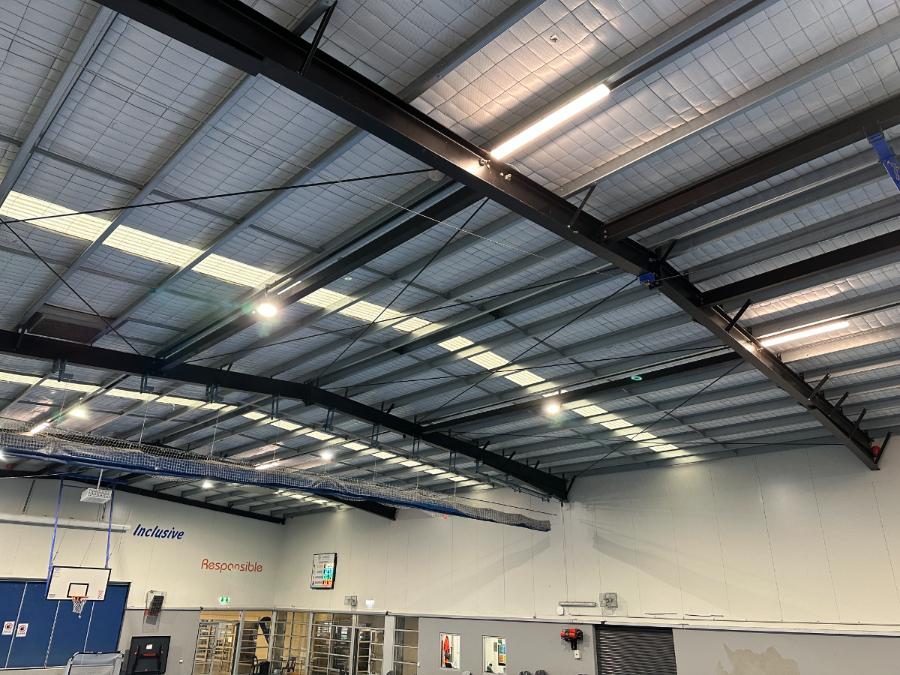
Lighting is usually the largest single electrical load in a warehouse, and it is almost always the easiest one to cut. Old metal halide and fluorescent high bays draw power continuously while the shift is on, and a large share of that power leaves as heat rather than light.
The question we get asked first is what the upgrade will actually save. The honest answer is that it depends on three numbers specific to your site, and any figure quoted without them is guesswork.
Where the savings come from
Lower draw per fitting. A 400W metal halide high bay is commonly replaced with an LED fitting somewhere in the 100W to 150W range, depending on the mounting height and the light level you need at floor level. That is the headline reduction, and on its own it is usually the bulk of the saving.
Controls. This is the part sites underestimate. Aisles, loading docks and cold stores are often lit at full output for the entire shift while nobody is in them. Motion sensors and daylight harvesting on perimeter runs can take a meaningful additional slice off the bill, and unlike the fittings themselves, controls can often be staged in later.
Maintenance. Replacing a failed high bay at height means a scissor lift, an access plan, and usually a stop to whatever is happening underneath it. Sites running a lot of fittings tend to find the avoided lamp changes and lift hire are worth as much as some of the energy saving, and they are the part that never shows up on the electricity bill.
Heat. In a cold store or an air-conditioned pick area, every watt of lighting is also a watt the refrigeration has to remove. The saving is counted twice in those spaces.
What actually determines your payback
Three things, in order of how much they move the result:
- Operating hours. A single-shift site and a 24-hour site have completely different economics for the same fittings. Hours matter more than the wattage difference does.
- Your tariff. The rate you pay, and whether you are exposed to demand charges as well as consumption charges. Lighting runs through the peak window on most sites, which is where the more expensive units usually are.
- The condition of what is there now. A site already running late-model fluorescents is a much smaller step than one running failing metal halides at 400W.
For a typical Melbourne warehouse running standard hours, payback periods in the two to four year range are common. Multi-shift and cold storage sites tend to land shorter, single-shift sites longer. We would rather work that out on your numbers than have you plan around ours.
Rebates
Victoria has energy efficiency incentive schemes that lighting upgrades can qualify for, and where a site is eligible the discount is applied through an accredited provider rather than claimed back later. Eligibility rules and the value of the incentive change from time to time, so we confirm what applies at the time of quoting rather than promising a figure up front.
What the work involves
For most warehouses this is not a disruptive job. Fittings are typically changed over on a lift, aisle by aisle, and we work around picking and despatch rather than through them. Where the existing wiring and mounting are sound, a straight changeover is common; where the old installation is at end of life, or where the layout has changed since it was installed, it is worth reviewing the circuit and the switchboard capacity at the same time rather than twice.
A word on light levels: matching the old lux reading is not always the right target. If the racking layout has changed since the original design, the lighting should follow the racking, not the other way round. It is common to end up with better light in the aisles and less wasted over the walls.
Where to start
The useful first step is a walk-through: fitting count, mounting heights, operating hours, and a look at the switchboard. From that we can put real numbers against your site instead of industry averages, and tell you whether controls are worth including now or later.
If you want that done on your site, get in touch and we will arrange a time.